Research for a Better World

Embracing the World: research for a better world

Through Amma's Amrita University, Embracing the World's volunteer researchers are breaking new ground in a broad range of highly specialized fields. Spanning a diverse array of disciplines including nanotechnology, biotechnology, robotics and satellite-enabled software solutions, the projects share a single goal: to harness the power of modern technology to provide effective, targeted aid to communities and individuals in crisis.

In 2009, ETW volunteer researchers at Amrita University deployed the world's first-ever wireless sensor network system for landslide detection.
On the cutting edge of emerging technologies, Embracing the World is developing haptic, biofeedback and virtual reality systems to bring vocational training capabilities into remote areas.
Using a satellite provided by the Indian Space Research Organization, ETW's AIMS Hospital has developed a telemedicine network connecting 32 centers across India, Led-Ladakh in Kashmir, and the islands of Lakshadweep and Andaman-Nicobar.
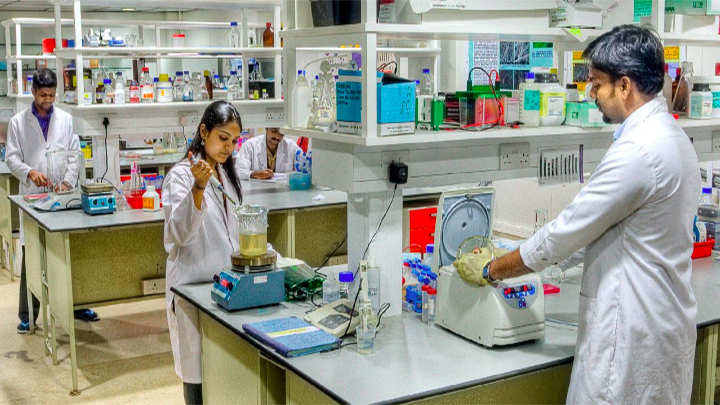
Through Amrita University's Center for Biotechnology, ETW volunteer researchers are developing state-of-the-art, cost-effective, automated biomedical devices.
In 2006, ETW volunteers founded India's first Nanobiotechnology Center, at our AIMS Hospital in Kochi, Kerala.
The first campus and administrative headquarters of Amrita University, managed by Amma's Ashram. Amrita University's infrastructure supports many ETW research projects.

Sensor Network System for Landslide Detection

In 2008, in India alone, 252 people lost their lives to rainfall-induced landslides. In other developing countries, the numbers are much higher.

In 2009, Embracing the World volunteer researchers at Amrita University deployed the world's first-ever wireless sensor network system for landslide detection. ETW volunteers also collaborated in the initial development of the system, along with 11 partner organizations across eight countries in a project initiated by the European Commission.
The system was deployed and continues to be monitored by ETW volunteers in Munnar, Kerala, an area prone to landslides which historically have caused significant loss of life. The system uses wireless sensor technology to provide advance warning of an impending landslide disaster, allowing for early evacuation and disaster management. The Government of India has shown interest in deploying this system in all landslide-prone areas.

back to top

SAVE

On the cutting edge of emerging technologies, Embracing the World is developing haptic, biofeedback and virtual reality systems to bring vocational training capabilities into remote areas.

In a project funded by the Government of India's e-learning program (Sakshat), Embracing the World volunteer researchers at Amrita University are developing multimedia-enriched computerized vocational training programs targeting India's largely illiterate indigenous population. The project, Sakshat-Amrita Vocational Education (SAVE), aims to overcome traditional barriers to providing training in occupational trades in remote areas. In the long run, computers and touch devices are cheaper and more accessible than tools and workshops. Normally, learning a skill such as plumbing requires hands-on practice using the tools of the trade under the guidance of an expert. But with touch-sensitive haptic devices, the actual tools can be replaced by a computer and a student can learn the new skill using virtual tools.

Courses include the use of haptic devices to simulate skills necessary to attain competency. The haptic devices are fully interactive, three-dimensional devices that provide sensory feedback to the user. Courses and evaluation modules are virtual and interactive. Courses developed by SAVE are available as prepackaged vocational-training modules that can be downloaded and used by any training center in India. Courses are developed with independent video- and audio-indexing so that conversion into the local dialect is relatively simple. Courses are currently delivered in English, Hindi and Malayalam. The long-term vision of SAVE is to outfit a Mobile e-Learning Unit that can travel to the target populations in rural areas, specifically for vocational training. This will eliminate transportation and location as obstacles to accessible education for India's indigenous population.

Telemedicine

Using a satellite provided by the Indian Space Research Organization, Embracing the World's AIMS Hospital has developed a telemedicine network connecting 32 centers across India, Led-Ladakh in Kashmir, and the islands of Lakshadweep and Andaman-Nicobar.

The network enables specialist doctors to examine, investigate, monitor and treat patients in remote areas through satellite video-conferencing. Medical images, patient records and output from medical devices can be transmitted, as well as live two-way audio and video. Specialists can advise doctors or paramedics at the patient's end, and even talk them through complex surgical procedures.

Embracing the World has also used the technology to provide specialized medical support during the 2004 Indian Ocean Tsunami and 2008 Bihar Floods, and to help doctors in remote areas get up to speed on the latest medical advancements through satellite-enabled seminars and workshops.

back to top

Nanotechnology

In 2006, Embracing the World volunteers founded India's first Nanobiotechnology Center, at our AIMS Hospital in Kochi, Kerala. The Center for Nanosciences is recognized today as a leader in nanotechnology research and education in the biomedical area. The Center's goal is to develop affordable, high-quality products utilizing the novel properties of nanomaterials. The Center receives funding from the Government of India's Department of Science and Technology / Department of Biotechnology and Industry. While the primary focus is on tissue engineering and stem cell research, the Center also conducts research on cancer diagnostics and drug delivery, developing biodegradable and thermoresponsive polymeric nanoparticles targeted for treatment of cancer, malaria, inflammation, transdermal and bone diseases.

back to top

Biomedical Devices

Through Amrita University's Center for Biotechnology, Embracing the World volunteer researchers are developing state-of-the-art, cost-effective, automated biomedical devices. The Center is currently working on a high-quality, low-cost automated insulin pump designed for the precise, personalized and continuous delivery of insulin in a subcutaneous manner. Simultaneously, attempts to develop an amperometric glucose sensor are also in progress. Together, the two devices when introduced into the field will allow for low-income diabetes patients to monitor and regulate their insulin levels in an easy and affordable manner.

back to top