English French Spanish German Italian Japanese

Education for Everyone

Education for everyone

Universal education has proven to be the most effective means of eliminating endemic poverty, and on an individual level has been shown to be the most sustainable escape from poverty’s clutches. Research has shown that every year of school increases an individual’s wages by 10 percent. This is true for both women and men, and the gains are even greater in developing countries. But throughout the developing world, going to school is rarely free. Students are required to pay their own transportation costs, purchase uniforms, textbooks, notebooks and pencils. Children who cannot afford these basic costs cannot attend school. As families struggle to stay above the poverty line, the additional expense of school becomes an unlikely investment. One out of three children worldwide never sets foot in a classroom. In India, only 6 – 8% of the population completes their secondary education.

For the past 20 years, Embracing the World has worked hard to help ensure that everyone who wants to go to school has an opportunity to do so. Most recently, we launched an initiative to identify and sponsor 100,000 talented but economically strapped children belonging to desperately impoverished agricultural communities. Beyond this, Embracing the World offers 75-l00 scholarships to each of the 53 highly competitive Amrita Vidyalayam schools run by the Mata Amritanandamayi Math throughout India. And given that a majority of women bear the responsibility of primary caretaker while they also represent 70 percent of the world’s poor, Embracing the World is also investing heavily in adult education, starting with our plan to provide vocational training and start-up capital to 100,000 women living below the poverty line. Research has shown vocational training to be an effective economic intervention among adults who did not have the opportunity to attend school and successfully enter the labor market.
 

Play
Prev
Next

Universal education has proven to be the most effective means of eliminating endemic poverty, and on an individual level has been shown to be the most sustainable escape from poverty’s clutches.

We believe its never too late to learn, and for the past 20 years ETW has worked to help ensure that everyone who wants to learn has an opportunity to do so.

Most recently, ETW launched an initiative to identify and sponsor 100,000 talented but economically strapped children belonging to desperately impoverished agricultural communities.

Experts say that at least 160,000 farmers have committed suicide in India since 1997.

In 2007, 45 Indian farmers took their own lives every day. The families left behind are burdened with staggering debts and no means to repay them.

Through Vidyamritam (Nectar of Love), ETW is working to provide scholarships to 100,000 children of farmers living below the poverty line.

Since the project was launched in September 2007, 32,000 students from the states of Maharashtra, Andhra Pradesh, Karnataka and Kerala have been enrolled in the program.

Many of the beneficiaries are children who have already lost one or both parents to suicide. The children (ages 10 to 15) receive a quarterly stipend until they complete their education.

Beyond this, Embracing the World offers 75-l00 scholarships to each of the 53 highly competitive Amrita Vidyalayam schools run by the Mata Amritanandamayi Math throughout India.

Research has shown that every year of school increases an individual’s wages by 10 percent. This is true for both women and men, and the gains are even greater in developing countries.

Recognizing the need for specialized education, ETW runs a school specifically for hearing-impaired children in Trissur, Kerala.

More than 120 children attend the boarding school, where they are also encouraged in dance and art.

Since 1989, ETW has run an Industrial Training Center, providing vocational training in 10 trades for 500 teenagers at a time.

One out of three children worldwide never sets foot in a classroom. In India, only 6 – 8% of the population completes their secondary education.

Given that a majority of women bear the responsibility of primary caretaker while they also represent 70 percent of the world’s poor, Embracing the World is also investing in adult education.

In 2008, Embracing the World’s project in Sivakasi, Tamil Nadu won the UNESCO / NLM national award for being the most effective and efficient government-sponsored adult education project in India.

ETW also aims to build 50 primary schools for Kerala’s tribal population.


100,000 Scholarships for Children of Farmers in Crisis

Agriculture makes up 17% of India’s GDP, and 50% of its employment share. If this sounds like a recipe for disaster, it is: in recent years, suicide has been spreading like an epidemic among independent farmers in India suffering from debt and crop failure. Experts say that at least 160,000 farmers have committed suicide in India since 1997. In 2006, in the Vidarbha region of Maharashtra alone, 1,044 suicides were reported in the agricultural community – that’s one every eight hours. And in 2007, 45 Indian farmers took their own lives every day.

In March 2007, after discussions with Maharashtra Chief Minister Vilasrao Deshmukh, Amma announced a massive project to address the problem. Embracing the World the recognized the only intervention that would adequately address the plague of farmer suicide was a long-term one that prevented the next generation from experiencing the same financial difficulties as their parents. Too overburdened with debt to afford education, thousands of children of farmers are unable to attend school. Through Vidyamritam (Nectar of Love), ETW is working to provide scholarships to 100,000 children of farmers living below the poverty line. Since the project was launched in September 2007, 32,000 students from the states of Maharashtra, Andhra Pradesh, Karnataka and Kerala have been enrolled in the program.

Many of the beneficiaries are children who have already lost one or both parents to suicide. The children (ages 10 to 15) receive a quarterly stipend until they complete their education. Embracing the World volunteers regularly verify the children are continuing their educations and that the funds are being used either for school fees or supplies.
Reports show that farmers in India are committing suicide over debts as small as $300 U.S. As such, the scholarships help keep children in school without adding to their parents’ sense of financial burden. Only if the children of such families receive proper educations will their families be freed from total dependence on agriculture as a source of income.

As an extension of this project, Embracing the World is conducting camps and programs for the scholarship recipients in order to help inculcate values and a sense of empowerment. One such program – for 25,000 scholarship recipients – was held at Embracing the World’s headquarters in Amritapuri, Kerala on 26 September 2009.

Embracing the World also conducts the Vidyamritam scholarship program in Nairobi, Kenya.

Industrial Training Center

But our education project is not limited to our efforts to provide new options and opportunities to India’s impoverished farmers. Since 1989, ETW has run an Industrial Training Center, providing vocational training in 10 trades for 500 teenagers at a time. The institution strives to build the confidence of the adolescents, giving them a sense of self-reliance so that they can take up their trade in a wide range of work environments or become self-employed. The center has more than an 80% graduation rate and is highly regarded by employers. After the 2004 Asian Tsunami, the ITC opened its doors to hundreds of local youth to help them rebuild their lives after the disaster.

School for the Hearing- and Speech-Impaired

People living with disabilities in India are a grossly underserved population. Due to the social stigma a family often faces with having a disabled child, many young people with hearing impairments are abandoned by their family, disconnected from society and cannot benefit from education given the lack of specialized services.

Recognizing the need for specialized education, Embracing the World runs a school specifically for hearing-impaired children in Trissur, Kerala. Amrita Speech and Hearing Improvement School is one of very few schools in Kerala that scientifically teaches hearing-impaired children to develop their speech capacity. Embracing the World took the school over in 1996 and has since constructed new facilities with specially trained the teachers. Instruction is intended to enable them to interact with other children and lead a normal, full and productive life. More than 120 children attend the boarding school, where they are also encouraged in dance and art. Class sizes are small, typically 6-8 students, to enable many repetitions of the study material. Given proper instruction, attention, care and love, up to 70% of these hearing-related disabilities can be cured in such children, provided the training is given from an early age. The children have a 100 percent pass rate in the Secondary School Leaving Certificate Exam and do very well in obtaining employment.

Reaching Out to Kerala’s Indigenous Population

A majority of those that fall below the poverty line in India are members of Scheduled Tribes, or the indigenous population. While they represent approximately 8 percent of the total population, Scheduled Tribe members make up 40 percent of the displaced population. Literacy among the indigenous population is less than half that of the general population – for the women, it is just one fourth that of the general population.

In order to best confront the unique challenges associated with providing adult education for South India’s indigenous population in remote areas lacking even basic infrastructure, ETW has engaged in a partnership with the Government of India under the Government’s adult education grant program (JSS). Under JSS, the Government funds NGOs all over India who are working in the field of adult education. JSS is funded with government grants recommended by UNESCO, in collaboration with the National Literacy Mission. In 2008, Embracing the World’s project in Sivakasi, Tamil Nadu won the UNESCO / NLM national award for being the most effective and efficient JSS project in India. This year, no awards were made.

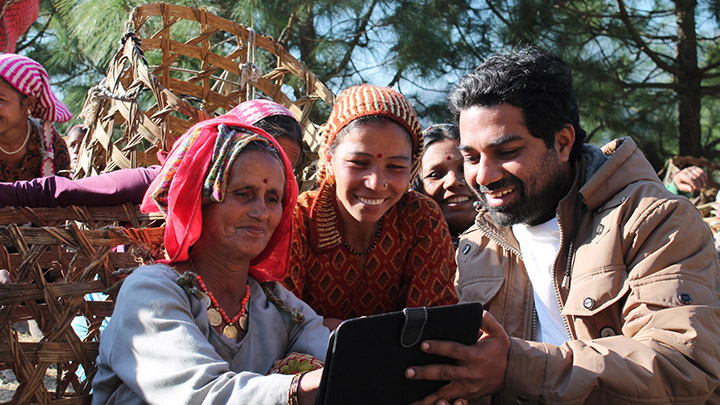
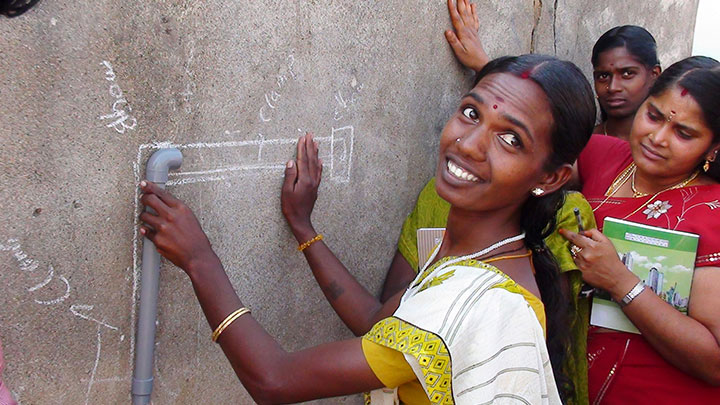
With the support of JSS funds, ETW runs literacy and vocational training programs serving the poorest tribal communities in Idukki, Kerala and Sivakasi, Tamil Nadu. ETW offers a range of more than 100 courses in occupations varying from candle making to computer science. ETW also encourages participants to “pay it forward” by going on to volunteer in their own communities. For example, participants in ETW’s school uniform tailoring program always donate their first uniform to a child who cannot afford one. Participants also go on to teach neighbors, friends and family how to read and write. Participants also volunteer their time in ETW’s suicide-prevention program. After completion of a training program with support of ETW volunteers, counselors go door to door in their own villages, to speak with and help individuals battle Kerala’s rising suicide and drug abuse rates. ETW also aims to build 50 primary schools for Kerala’s tribal population. 10 schools are already completed and operational. Additional projects will focus on preserving traditional tribal reforestation practices, promote environmental protection in tribal areas, and provide training in traditional agricultural practices and the establishment of model farms.

Project for Tribal People

One of the main objectives of this project is to empower tribal people to build informal schools in Kerala. ETW has acquired the first 10 sites for these schools in Attappadi, a tribal area in Palakkad District, Kerala. Three schools have been built so far. The project also aims to provide vocational training for adults. Research has shown vocational training to be an effective economic intervention among adults who did not have the opportunity to attend school and successfully enter the labor market. AIMS Hospital has trained 150 people to work as part of the Amrita Kripa Hospital’s mobile-clinic outreach programs in Kalpetta.

back to top