2004 Indian Ocean Tsunami

The 2004 Indian Ocean Tsunami hit wide swathes of India's east coast, along the shores of Tamil Nadu, where 7,000 people were killed. On the west coast, a 20-kilometer stretch of Kerala was also hit, including the peninsula on which Amma's Amritapuri Ashram and headquarters of Embracing the World stands. In the neighboring villages, 140 people were killed. Thousands of people, including the 20,000 people in Amma's Ashram that day, were evacuated under Amma's direct supervision. Within hours, Amma's nearby Amrita University was converted into a giant relief camp, with food, shelter, clothing and medical attention being provided for the survivors. Amma's monastic disciples assisted with ceremonial cremations of the bodies of their loved ones who lost their lives in the disaster.

Within days, Amma announced that Embracing the World was pledging to provide $23 million U.S.D. in aid for the tsunami victims in India. Separately, after Amma met with the President of Sri Lanka, ETW offered $685,000 U.S.D. for relief work in both Sinhalese and Tamil communities. For the next two years, under Amma's careful guidance and supervision, Embracing the World volunteers looked after every aspect of the victims' needs - fulfilling not only basic needs but providing homes and infrastructure far superior to what they had lost; psychological counseling to help them get back on their feet; and vocational training so that they did not have depend for their livelihood on the unpredictable sea. This opened new doors for both men and women, who were often taking up employment for the first time in their lives.

By the end of 2006, after two years of relief work, the actual cost of Embracing the World's tsunami-relief work reached $46 million U.S.D.

Relief Camps
Medical Aid
7.5 million meals
Clothing and Other Necessities
Tsunami Housing Project - 6,200 Homes
Trauma Rehabilitation
Children's Camps
Vocational Training and Employment Opportunities
Direct Assistance for Fishermen
Financial Aid
Sponsored Weddings
Evacuation Bridge
Project: GreenShore

back to top

ETW volunteers built funeral pyres for the 140 people who lost their lives to the tsunami in the area around ETW's headquarters in Kerala.
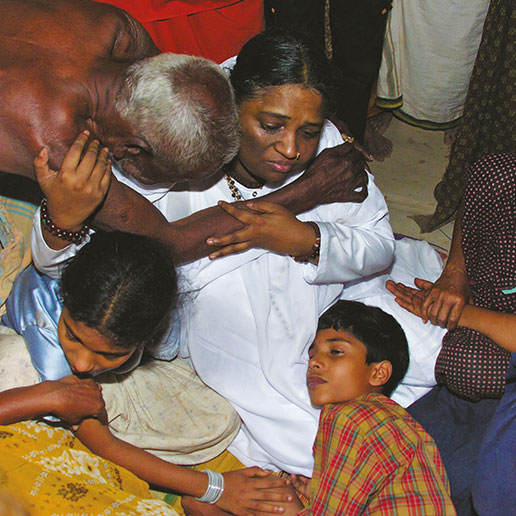
On India's west coast, 7,000 people were killed. Amma moved among the victims in ETW's relief camps on both coasts, consoling the victims and identifying their immediate needs.
Many of the survivors had lost every member of their immediate family, along with their homes and possessions.
ETW volunteers from around the world flew in to help in the relief efforts.
Less than three weeks after the disaster, construction of nine shelters was complete -- each equipped with electricity, ceiling fans, separate bathrooms, running water and TVs.
Eleven ambulances and teams of doctors and nurses rushed to the affected areas and set up multiple 24-hour medical centres on the east and west coasts of India. Over the following four months, 30,000 patients were treated in 100 camps.
A telemedicine center was set up at the ETW's temporary shelters in Alappad Panchayat, connecting the doctors stationed there with AIMS Hospital in Cochin via satellite. ETW's AIMS Hospital also performed major surgeries for 450 tsunami victims, including 15 cardiac operations.
Within days, Amma announced that Embracing the World was pledging to provide $23 million U.S.D. in aid for the tsunami victims in India. By the end of 2006, after two years of relief work, the actual cost of Embracing the World's tsunami-relief work reached $46 million U.S.D.
On the day of the disaster, thousands of people, including the 20,000 people in Amma's Ashram that day, were evacuated under Amma's direct supervision.
For more than four months afterwards, ETW served 10,000 meals three times a day at relief camps and at 18 food counters in the tsunami-affected area on India's west coast.
At the Nagapattinam relief camps in Tamil Nadu, 675,000 meals were prepared and served within a radius of 15 km.
In total, as part of its tsunami aid package, Embracing the World served more than 7.5 million meals throughout Tamil Nadu and Kerala.
In Kerala, ETW distributed the equivalent of $350,500 U.S.D. in cash to help 16,000 families to purchase cooking vessels.
ETW also distributed school supplies for students various educational aids, including 10,000 textbooks, 5,000 pens, compasses, rulers, dictionaries, and notebooks.
The core of ETW's massive tsunami-relief project was the construction of 6,200 houses in the Indian states of Kerala, Tamil Nadu and in the Andaman & Nicobar Islands, as well as in Sri Lanka.
In both Tamil Nadu and in Kerala, ETW was the ?rst non-governmental organization to complete tsunami-relief houses according to government standards.
As of October 2008, all houses had been completed and distributed.
In many places, ETW built not just houses, but also roads, wells, schools, community halls and healthcare centers.
At a cost of $1 million U.S.D., Embracing the World distributed a total of 700 fishing boats, complete with engine, handle and propeller, and nets, to villagers who had lost theirs in the tsunami. Each boat supports 7 families.
Over 2,500 people received vocational training. According to their educational qualifications, they were trained to be teachers, nurses, paramedical assistants, electricians, security officers, drivers, masonry workers, carpenters, and mechanics.
During the training period, the students received a monthly stipend, as well as free food, uniforms, and accommodations. Upon successful completion of the training, Embracing the World helped each of them to find a job.
ETW conducted special training programs in yoga, English and Sanskrit for children from the tsunami-affected areas. More than 10,000 girls and boys underwent these courses.
Since the tsunami had left many children afraid of water, Amma personally took the children to the ashram's swimming pool to help them overcome this fear.
one of the mothers who lost their children in the tsunami had previously undergone tubal-ligation as a form of permanent contraception. ETW offered such women the opportunity to undergo fallopian-tube recanalization to reverse their sterilization surgeries. As of October 2008, all six mothers had given birth, three of whom had twins.
After witnessing the overcrowded boats and the amount of time involved in two false "tsunami alerts" that took place in early 2005, Amma decided to build a bridge connecting the peninsula of Alappad Panchayat with mainland Kerala. The bridge provides a centralized escape route for 15,000 people to evacuate in 30 minutes should Alappad face another natural disaster.
For two years after the tsunami, For the next two years, under Amma's careful guidance and supervision, ETW volunteers looked after every aspect of the victims' needs -- fulfilling not only basic needs but providing homes and infrastructure far superior to what they had lost; psychological counseling to help them get back on their feet; and vocational training so that they did not have depend for their livelihood on the unpredictable sea.

Relief Camps

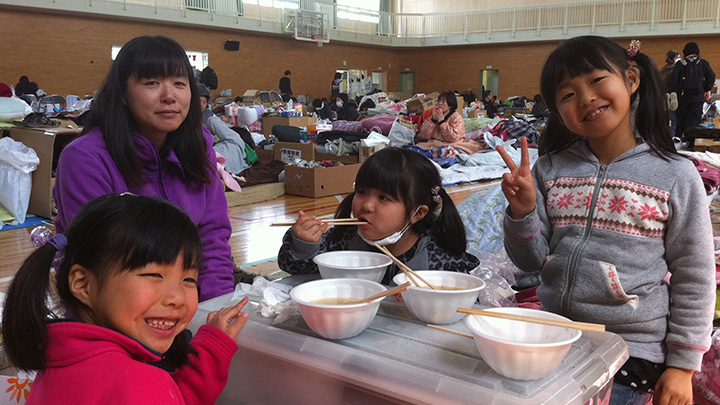
On the day of the disaster, despite its headquarters being submerged in several feet of water, Embracing the World created three relief camps at the local campus of Amma's Amrita University on the mainland across from the peninsula. About 4,000 people stayed there for the first 15 days after the tsunami. About 2,000 of these remained there for four months.


On January 13th, 2005, construction of nine shelters was complete - each equipped with electricity, ceiling fans, separate bathrooms, running water and TVs. In Alappad, Kerala and in Saman-thampettai, Tamil Nadu, ETW provided shelter for 550 families. At the relief camps, ETW volunteers organized sporting events, as well as music and dance programs to entertain the refugees.

Relief camps were also set up on the Andaman & Nicobar Islands. Further, Embracing the World loaned five acres of land to Kerala's state government to construct additional temporary shelters.


back to top

Medical Aid

Eleven ambulances and teams of doctors and nurses rushed to the affected areas and set up multiple 24-hour medical centres on the east and west coasts of India. The ambulance teams provided on-the-spot intensive care, initially visiting each relief camp every two hours. The medical teams continued making rounds of tsunami-affected areas for four months. Over 30,000 patients were treated in nearly 100 camps all over Kerala and Tamil Nadu. A telemedicine center was set up at the ETW's temporary shelters in Alappad Panchayat, connecting the doctors stationed there with AIMS Hospital in Cochin via satellite. ETW's AIMS Hospital also performed major surgeries for 450 tsunami victims, including 15 cardiac operations. ETW set up 20 eye camps, performed 115 cataract operations, and distributed 400 spectacles to those who lost their eyeglasses during the tsunami.

ETW provided appropriate care for 16 tsunami victims throughout their pregnancies and deliveries. Some of the mothers who lost their children in the tsunami had previously undergone tubal-ligation as a form of permanent contraception. With the shock of their irrevocable loss, some became depressed, even suicidal. Embracing the World offered such women the opportunity to undergo fallopian-tube recanalisation to reverse their sterilization surgeries. Six women underwent the procedure at AIMS Hospital. ETW covered all the expenses. As of October 2008, all six mothers had given birth, three of whom had twins.

back to top

7.5 million meals

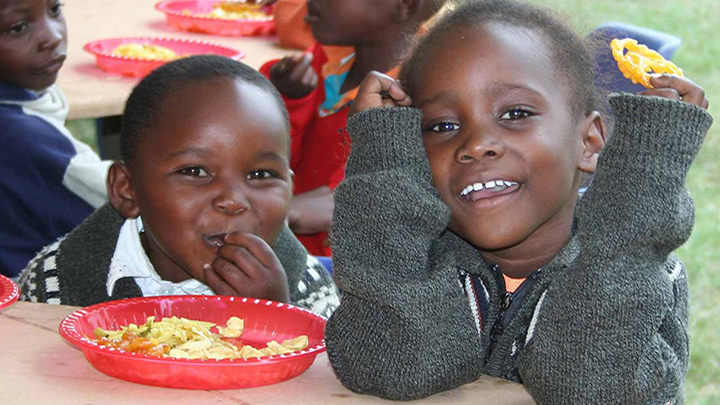
15 minutes after the tsunami struck, ETW volunteers began preparing food for village evacuees. Food was prepared for the 2,000 village evacuees in its own camps, as well as for 15,000 people in 12 government shelters. The same day, 40 trucks of raw rice and foodstuffs were transported to affected areas. For more than four months afterwards, ETW served 10,000 meals three times a day at relief camps and at 18 food counters in the tsunami-affected area on India's west coast.  ETW even provided school lunches for children who were staying at the relief camps.

In Kerala, ETW distributed 30,000 kg of rice during the first 15 days. Another 20,000 kg of rice were distributed to the evacuees on the day they left the relief camp.

Beginning just one day after the disaster, meals were also provided to victims on India's east coast, where the damage was much more extensive. At the Nagapattinam relief camps in Tamil Nadu, 675,000 meals were prepared and served within a radius of 15 km. Also in Tamil Nadu, ETW distributed 185 tons of uncooked rice and several tons of other staple food. In Chennai, a total of 56,000 meals were provided. During her visit to Nagapattinam, Amma personally distributed 6,000 bags of rice. Staple foods such as rice and beans were also distributed in Sri Lanka. In total, as part of its tsunami aid package, Embracing the World served more than 7.5 million meals throughout Tamil Nadu and Kerala.

back to top

Clothing and Other Necessities

In the days and weeks after the tsunami struck, ETW distributed thousands of relief kits to victims of the disaster. Relief kits included clothing, sandals, sleeping mats, bed sheets, and other essential items.


ETW provided 70,000 articles of clothing and 30,000 blankets for tsunami victims in India. Additionally, affected children were provided with 10,000 sets of tailored-to-fit clothes. All clothes were brand new.

ETW also distributed school supplies for students various educational aids, including 10,000 textbooks, 5,000 pens, compasses, rulers, dictionaries, and notebooks.

back to top

Tsunami Housing Project For 6,200 Homes

The core of ETW's massive tsunami-relief project was the construction of 6,200 houses in the Indian states of Kerala, Tamil Nadu and in the Andaman & Nicobar Islands, as well as in Sri Lanka. In both Tamil Nadu and in Kerala, ETW was the first non-governmental organization to complete tsunami-relief houses according to government standards. As of October 2008, all houses had been completed and distributed. Houses in Sri Lanka were completed in 2007. In many places, ETW built not just houses, but also roads, wells, schools, community halls and healthcare centers.

Out of his admiration for ETW's work, India's then-President Dr. A.P.J. Abdul Kalam visited one of the tsunami housing construction sites in Tamil Nadu and participated in a house-key-distribution ceremony at ETW's headquarters in Kerala.

back to top

Trauma Rehabilitation

In addition to economic loss, psychological trauma is inherent to the aftermath of any disaster. When not addressed early on, rehabilitation becomes even more difficult and sometimes impossible. Within a few days after the tsunami, ETW organized a team of psychiatrists, psychologists and social workers to begin counseling families. Many survivors experienced symptoms of Post-Traumatic Stress Disorder, especially those who witnessed their children and loved ones drown. Art therapy is a recognized psychological intervention that helps children who witness horrific experiences such as the loss of a parent, express their grief and pain. Trauma can only be addressed once it is identified. The counselors helped the children and adults to express and cope with their pain. The children were encouraged to draw and paint as part of their therapy, and many drew pictures of flooded villages and people clinging to coconut trees to save themselves. ETW also provided swimming lessons for the children to help them overcome their newly discovered fear of water.  These rehabilitative efforts gave families the courage to return to their seaside villages.

back to top

Childrens' Camps

ETW conducted special training programs in yoga, English and Sanskrit for children from the tsunami-affected areas of Kollam and Alappuzha, Kerala. More than 10,000 girls and boys underwent these courses, which were held on April 25th-29th and May 22nd-24th, 2005.

On each occasion approximately 5,000 children stayed at Amma's Ashram. Since the tsunami had left many children afraid of water, Amma personally took the children to the ashram's swimming pool to help them overcome this fear. They were also given opportunities to express their talents and perform cultural programs. For many children, it was the first time they had received any cultural education.

back to top

Vocational Education, Training and Employment Opportunities

After the tsunami, villagers asked Amma to help them find employment that did not require them to rely on the sea. This opened the door for men to learn new trades and for women to take up employment, often for the first time. It also gave birth to Embracing the World's Project: Economic Development.

Over 2,500 people received vocational training. According to their educational qualifications, they were trained to be teachers, nurses, paramedical assistants, electricians, security officers, drivers, masonry workers, carpenters, and mechanics. During the training period, the students received a monthly stipend, as well as free food, uniforms, and accommodations. Upon successful completion of the training, Embracing the World helped each of them to find a job.


ETW also provided free tailoring courses and sewing machines to 300 tsunami-affected village women in Kerala. Graduates are now making approximately Rs. 2,000 per month stitching clothing. Similar classes are took place in Nagapattinam, Tamil Nadu.


In Nagapattinam District, Tamil Nadu, ETW provided free hostel accommodations for 24 college students, free computer training for 200, and free general (1st-12th standard) tuition to 750 others. Spoken English classes were also taught free of charge.


35 children whose families were affected by the tsunami received free education and hostel accommodations at Amrita Sanskrit Higher Secondary School in Paripally, Kerala, run by Amma's Ashram.

back to top

Direct Aid for Fishermen

At a cost of $1 million U.S.D., Embracing the World distributed a total of 700 fishing boats, complete with engine, handle and propeller, and nets, to villagers who had lost theirs in the tsunami.  Each boat supports 7 families.


In June 2005, in partnership with the Indian Space Research Organization, Embracing the World's Village Satellite Resource Centre began providing GPS information regarding the best fishing locations to fishermen in Nagapattinam.

back to top

Financial Aid Packages

In Kerala, Embracing the World distributed the equivalent of $350,500 U.S.D. in cash to help 16,000 families residing in the tsunami-affected districts of Kollam, Ernakulam and Alappuzha to purchase cooking vessels.


Individuals already participating in ETW's existing monthly financial aid received an additional aid package. Many tsunami-affected families in Kerala and Tamil Nadu were enrolled in ETW's program to provide monthly financial aid for 100,000 people living below the poverty line.

Sponsored Weddings

ETW conducted hundreds of marriages for tsunami-affected couples in Kerala, Tamil Nadu and Pondicherry. All the costs of the marriage ceremonies were covered by ETW, including the wedding ornaments, clothes, and the traditional reception dinner for the couples' relatives. In Tamil Nadu, the newlyweds were provided with furniture, cooking vessels and other items needed to start their lives anew.

back to top

Evacuation Bridge

On December 20th 2006, the President of India, Dr. A.P.J. Abdul Kalam, inaugurated the bridge built by ETW to connect the peninsula of Alappad Panchayat with mainland Kerala. Amma decided to build the bridge after witnessing the overcrowded boats and the amount of time involved in two false "tsunami alerts" that took place in early 2005. The bridge provides a centralized escape route for 15,000 people to evacuate in 30 minutes should Alappad face another natural disaster. The bridge, which took only one year to complete, was completely paid for and constructed by ETW, at a cost of $1.32 million U.S.D.

Project: GreenShore

Through Project: GreenShore, ETW planted 100,000 Casuarina saplings on the beaches of the tsunami-affected area on India's west coast, in order to serve as a barrier against surging water from storms and future tsunamis. The trees will also protect the beaches from soil erosion. Approximately 650 villagers are participating in this project. The saplings were provided by Kerala's Department of Forestry, while ETW provided the volunteer manpower, as well as water tanks and pipes for watering the saplings.

back to top