Care Homes for Children

Embracing the World: Care Homes for Children

According to UNICEF, 145 million orphans were accounted for as of December 2008, of which 25 million reside in India. Every day, 5,760 more children become orphans. But these figures hide another, much larger number of children whose parents lack the resources to properly provide for them. Embracing the World currently runs two care homes for a total of more than 600 children - one in Paripally, Kerala and one in Nairobi, Kenya.

Care Home for Children - Paripally, Kerala


More than 20 years ago, the administrators of an orphanage for more than 500 children in the Kollam District of Kerala came to Amma with a problem. They were out of volunteers, out of money and with bills piling up, out of time. Before long, the administrators told Amma, they would have no choice but to turn the children out on the street. Moved by the children's plight, Amma diverted the money that had been saved to build her headquarters' first prayer hall to adopt the orphanage instead.

After adopting the orphanage, when the first ETW volunteers went to inspect the facility, they were appalled. The children were living in utter squalor. The children survived on just one meal a day, and drank unfiltered, dirty water. Their clothes were tattered and worn. They had no hygienic means to take a bath or go to the toilet. Their rooms were dark, dirty and crowded. They had no books, no medicine, and no hope.

Renovations began immediately. One by one, the dilapidated buildings were completely remodeled and in some cases entirely rebuilt. A septic and sewage system was installed, along with sources of clean water for drinking, cooking and bathing. A new kitchen was built where the children's food could be prepared in a hygienic environment. Finally, Embracing the World renovated and greatly expanded the attached school.

Residents of ETW's Care Home for Children in Kerala relax between classes
The children regularly win awards in Sanskrit, music, sports and dance
The children attend the highly competitive Amrita Sanskrit Secondary School, managed by the Mata Amritanandamayi Math
The love and affection the children receive from ETW volunteers gives them the strength to overcome their often-painful personal histories.
Many of the children come from indigenous tribal areas in Kerala's remote hill stations.
The children receive confidence-building sessions in public speaking and stress management from ETW volunteers.
The quality education and loving care the children receive from ETW volunteers gives them hope for a bright future.

Today, the children receive three nourishing meals a day and have all their nutritional, medical, emotional and academic needs attended to. They attend the now highly competitive Amrita Sanskrit Higher Secondary School. The children have their own playground, cultural club, dance and performance halls. The students consistently win statewide awards in music, sports and dance. But we believe it is the loving care, personal attention and endless encouragement they receive from ETW's dedicated team of volunteers - and in no small part their personal bond with Amma herself - that makes all the difference for these children. Their backgrounds are full of every kind of tragedy and horror, and yet with ETW each child finds a way to overcome their past and move forward with confidence and hope.

Some of the children, hailing from indigenous tribes living in abject poverty, do have parents but they are simply too poor to take care of the children. With the parents' consent, the children come to the care home to receive hope, wholesome meals, loving care and the education that they cannot get at home. Their caretakers take them to their villages on school holidays so the children's relatives better understand the ongoing relationship between home and school. Some children even become village "teachers." The sense of safety, security and support they receive at the care home helps the children to better concentrate on their studies and see that they fulfill a purpose. More than a third of our children even go on to earn college degrees. Those that don't, receive vocational training and job placement assistance from ETW volunteers.

Care Home for Children - Nairobi, Kenya

The AIDS epidemic has left behind more than one million orphaned children in Kenya. Even for families unaffected by AIDS, it is becoming more and more difficult to make ends meet; costs of living are rising, and drought and famine throughout 2008-2009 have increased food scarcity levels. Many parents have been forced to remove their children from school, in order to send them to work.

During Amma's visit to Nairobi in April 2009, she officially inaugurated Amrita Watoto Boma, a children's care home for 108 children spread over 11 acres on the banks of the Athi River. Managed and run by Embracing the World volunteers, the home provides shelter, food, education and healthcare in a loving environment. The first 54 children were taken in during Amma's program, with Amma personally distributing to each of them new sets of clothing and school supplies. Ages of the children range from six to 14. Many of the children have lost one or both parents to AIDS; others come from families who cannot afford to provide for them.

An additional 54 children will be taken in when the facilities expand. When Amrita Watoto Boma is completed, it will include dormitories, classrooms, a playground, sports facilities and medical clinic.

All those interested in supporting Amrita Children?s Home in Kenya Amrita Watoto Boma) in any way (cash, kind, volunteering) are requested to contact MA Center, USA, directly.

Ron Gottsegen
President, MA Center, USA

The AIDS epidemic has left behind more than one million orphaned children in Kenya.
In April 2009, Amma visited Nairobi to inaugurate ETW's second Care Home for Children, the Amrita Watoto Boma.
Amma presented the children with new school uniforms and school supplies.
When Amrita Watoto Boma is completed, it will include dormitories, classrooms, a playground, sports facilities and medical clinic.
For many of the children, it was the first time they could remember receiving gifts.
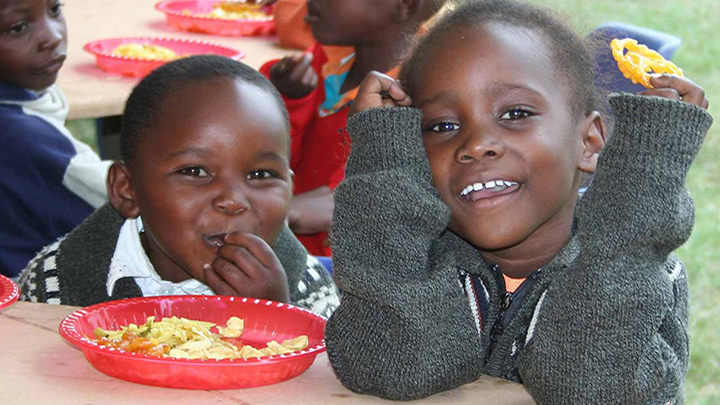
Drought and famine throughout 2008-2009 have increased food scarcity levels throughout Kenya. Some of the children at ETW's Care Home are receiving regular meals for the first time.
Wearing their new uniforms, the children board their own school bus, also provided by ETW.