SRI MATA AMRITANANDAMAYI DEVI (AMMA)

Founder, Embracing the World
Founder & Chairperson, Mata Amritanandamayi Math
Founder & Chairperson, Mata Amritanandamayi Charitable Trust
Founder & Chairperson, Mata Amritanandamayi Mission Trust
Chancellor, Amrita Vishwa Vidyapeetham University
Founder, Amrita Institute of Medical Sciences (AIMS Hospital)

Sri Mata Amritanandamayi Devi is known throughout the world as Amma, or Mother, for her selfless love and compassion toward all beings. Her entire life has been dedicated to alleviating the pain of the poor and those suffering physically and emotionally. Amma inspires, uplifts and transforms through her physical embrace, her spiritual wisdom and through Embracing the World. Throughout her life, Amma has embraced and comforted more than 30 million people. When asked where she gets the energy to help so many people while simultaneously running a massive humanitarian organization, Amma answers: "Where there is true love, everything is effortless."

Amma's Biography:

Early Years

Defying Convention with Courage and Compassion

Embracing the World

EARLY YEARS

Amma was born into a simple family of Kerala fisher-folk in 1953. Even as a small girl, she drew attention with the many hours she spent in deep meditation on the seashore. She also composed devotional songs and could often be seen singing to the divine with heartfelt emotion. Despite her tender age, her compositions revealed remarkable depth and wisdom.

Amma's parents could not understand her. Amma explains, "In India, women are expected to remain in the background. It is said that 'Even the walls should not hear them.' My family could not understand my way of reaching out to people; they had no idea of the spiritual principles."

Amma's mother became ill when Amma was nine, and Amma was withdrawn from school in order to help with household tasks and the care of her seven siblings. As she gathered food scraps from neighbors for her family's cows, she was confronted with the intense poverty and suffering of others.

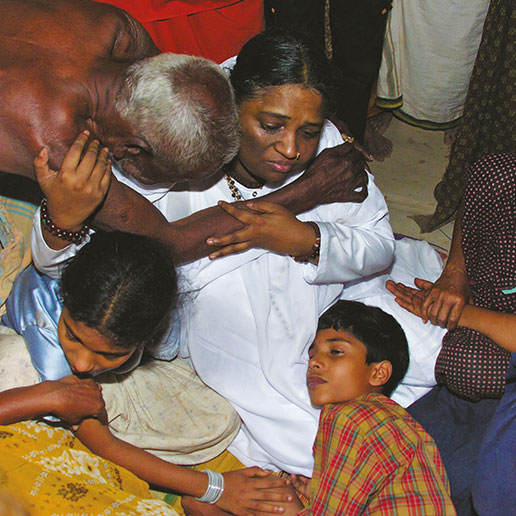
Amma brought these people food and clothing from her own home. Her family, which was by no means wealthy, scolded and punished her. Amma also began to spontaneously embrace people to comfort them in their sorrow. Responding to her affectionate care, they began to call her Amma (Mother). In turn, she naturally referred to them as her children.

DEFYING CONVENTION WITH COURAGE AND COMPASSION

Amma was deeply affected by the profound suffering she witnessed. According to Hinduism, the suffering of the individual is due to his or her own karma - the results of actions performed in the past. Amma accepted this concept, but she refused to accept it as a justification for inaction. Amma contemplated the principle of karma until she revealed an even more profound truth, asking a question which she continues to ask each of us today.  "If it is one man's karma to suffer, isn't it our dharma (duty) to help ease his suffering and pain?"
With this simple yet profound conviction - that each of us has a responsibility to lend a helping hand to those less fortunate - Amma moved forward with confidence in her life of service and compassionate care for all beings, uniquely expressed by the motherly embrace she offers to all who seek solace in her arms.

In Amma's community, it was not permissible for a 14-year-old girl to touch others, especially men. But despite adverse reactions by her parents, Amma followed her heart, later explaining, "I don't see if it is a man or a woman. I don't see anyone different from my own self. A continuous stream of love flows from me to all of creation. This is my inborn nature. The duty of a doctor is to treat patients. In the same way, my duty is to console those who are suffering."

Amma says that love expressed is compassion, and compassion means accepting the needs and sorrows of others as one's own. More than 20 years ago, the administrators of a local orphanage confessed to Amma that they were out of funds. They told Amma that before long, they would have no choice but to turn the children out on the street. Amma diverted the money that had been saved to build her ashram's first prayer hall and used it to assume the care for the orphans instead. With this, Embracing the World was born.

EMBRACING THE WORLD:

Today, Amma's birthplace in Kerala has become the worldwide headquarters of Embracing the World. Home to 3,000 people, thousands more visit every day from all over India and the world. The center's residents and visitors alike are inspired by Amma's example and dedicate themselves to making a difference in the lives of those less fortunate.

While Amma is widely regarded as India's foremost spiritual leader and one of the guiding lights of Hinduism, Amma says that her religion is love. Amma has never asked anyone to change their religion but only to contemplate the essential principles of their own faith and to try to live accordingly. Amma often comments, "In today's world, there are many who are willing to die for their religion, but no one is willing to live according to their religion's principles."
During the last 15 years, Amma has been regularly invited to speak at international forums. In 1993, the Parliament of the World's Religions Centennial named her President of the Hindu faith. She delivered a keynote address at the United Nations' Millennium World Peace Summit and was presented with the 2002 Gandhi-King Award for Non-violence. In 2006, Amma - along with 2005 Nobel Peace Prize winner Mohamed El Baradei - was presented with the James Parks Morton Interfaith Award by the Interfaith Center of New York for her role as an outstanding spiritual leader and humanitarian.
Every year, more and more people are drawn to Amma.  Truly a citizen of the world, she travels throughout India, Europe, the United States and Australia, as well to Japan, Sri Lanka, Singapore, Malaysia, Canada, Africa and South America. Wherever Amma goes, she holds free public programs including a talk, devotional singing and guided meditation. In her talks, she offers words of wisdom and guidance on both personal fulfillment as well as the most pressing matters of our time. And to this day, she concludes every program by embracing each person attending the event. It is this singular act that has become both catalyst and symbol for a movement that grows stronger with each passing day.